

In 2026, companies have moved past asking whether they should use artificial intelligence. The real question today is simple: Which platform makes AI genuinely useful in daily work?
That is where HubSpot stands out. Instead of treating AI as an added feature or a separate tool, HubSpot weaves intelligence right into the software teams already rely on for marketing, sales, service, content, and deal management. By building AI directly around its Smart CRM and Agent Hub, HubSpot gives businesses one unified place to keep data clean, automate repetitive steps, and create better customer experiences without losing control.
Here is an in-depth look at why HubSpot’s practical approach to AI is helping modern businesses scale faster and work smarter.
Why 2026 is the Year AI Got Practical
For a long time, business AI felt like a series of flashy demos—tools that could generate clever text or build a basic chatbot, but struggled to handle complex business operations. In 2026, the trend has shifted completely toward practical utility.
HubSpot positions AI as a daily helper rather than a futuristic concept. Its tools are built to help teams:
- Boost daily productivity by eliminating manual admin work.
- Analyze customer touchpoints, including phone calls, emails, and online meetings.
- Spot bottlenecks early before small operational delays turn into bigger customer churn problems.
Because the tools are embedded inside familiar workflows, employees do not have to spend time toggling between different tabs or copying data from one app to another. They simply get work done faster in the software they already open every morning.
A Connected Platform Built Around Real Business Workflows
The main reason software implementations fail is friction. When a company uses ten different single-purpose apps, information gets trapped in isolated silos. Marketing doesn’t know which leads sales contacted, and customer support doesn’t know what marketing promised.
HubSpot solves this problem through a connected ecosystem. On one unified platform, it links:
- Marketing Hub & Content Hub for lead generation, campaign creation, and brand messaging.
- Sales Hub & Revenue Hub for pipeline tracking, automated follow-ups, and deal closes.
- Service Hub for quick ticket resolution and 24/7 customer assistance.
- Data Hub & Smart CRM to act as the single source of truth across all channels.
                 ┌────────────────────────────────┐
                 │       HubSpot Smart CRM        │
                 │   (Unified Data & Records)     │
                 └──────────────┬─────────────────┘
                                │
        ┌───────────────────────┼───────────────────────┐
        ▼                       ▼                       ▼
┌───────────────┐       ┌───────────────┐       ┌───────────────┐
│ Marketing Hub │       │   Sales Hub   │       │  Service Hub  │
│  & Content    │       │   & Revenue   │       │  & Support    │
└───────────────┘       └───────────────┘       └───────────────┘
When these departments talk to each other naturally, AI gains total context. A sales rep reaching out to a lead can see what blog posts that prospect read, while a support agent resolving a ticket can see the company’s full billing and renewal status.
Smart CRM Gives AI the Context It Needs
Artificial intelligence is only as good as the information it can reach. If your CRM is filled with missing records, duplicate profiles, or outdated deal statuses, AI answers become vague or plain wrong.
HubSpot’s Smart CRM functions as the anchor for its AI ecosystem (known as Breeze). The system gathers contact interactions, deal stages, and customer queries into clean, structured records.
When AI tools draw from this structured environment, the results improve instantly:

- Accurate Personalization: Outreach messages use actual account context rather than generic templates.
- Smarter Insights: Meeting summaries and email analytics highlight real buying intent.
- Fewer Errors: Grounding AI in verified CRM data prevents hallucinated or irrelevant responses.
HubSpot takes a refreshingly honest stance here: clean data leads to great AI results. By encouraging good data hygiene, it helps companies build a foundation that pays off across every department.
Agent Hub: Making AI Operational, Not Experimental
One of the standout developments in 2026 is Agent Hub (building on HubSpot’s Breeze Agents). In many organizations, employees experiment with AI in piecemeal ways—using one browser extension for writing, another app for support answers, and a third service for account research. That creates risk and chaos.
Agent Hub brings those autonomous helpers under one roof. It acts as a central control center where business leaders can:
- View active AI agents running across marketing, prospecting, and customer care.
- Track agent performance to confirm they are meeting quality standards.
- Build custom agents using no-code tools (via Breeze Studio) where teams simply combine plain-text prompts, knowledge docs, and live CRM data.
Because non-technical teams can set up these workflows without waiting for a developer, the barrier to adopting modern automation disappears.
How AI Unites Marketing, Sales, and Support
To understand why HubSpot feels so cohesive, it helps to see how its tools handle a typical customer journey:
[ Marketing Attracts ] ──► [ Sales Engages ] ──► [ Service Delivers ]
        │                          │                         │
   Content & Ads             Prospecting &             Customer Agents &
  Lead Automation             Deal Insights             Ticket Workflows
1. Marketing
Marketers use built-in AI tools to outline content ideas, generate multi-channel campaigns, and automatically adjust targeting based on user behavior. Instead of spending days formatting assets, marketing teams can deploy campaigns in hours.
2. Sales
Prospecting agents monitor intent signals, identify high-fit accounts, and draft personalized initial outreach. Once a conversation starts, sales reps get instant summaries of past interactions so they can enter every call prepared.
3. Service
AI customer agents handle routine, around-the-clock inquiries using verified knowledge base articles. When complex issues arise, the AI hands off the full history to a human support agent without forcing the customer to repeat themselves.
Moving Faster with Breeze Intelligence
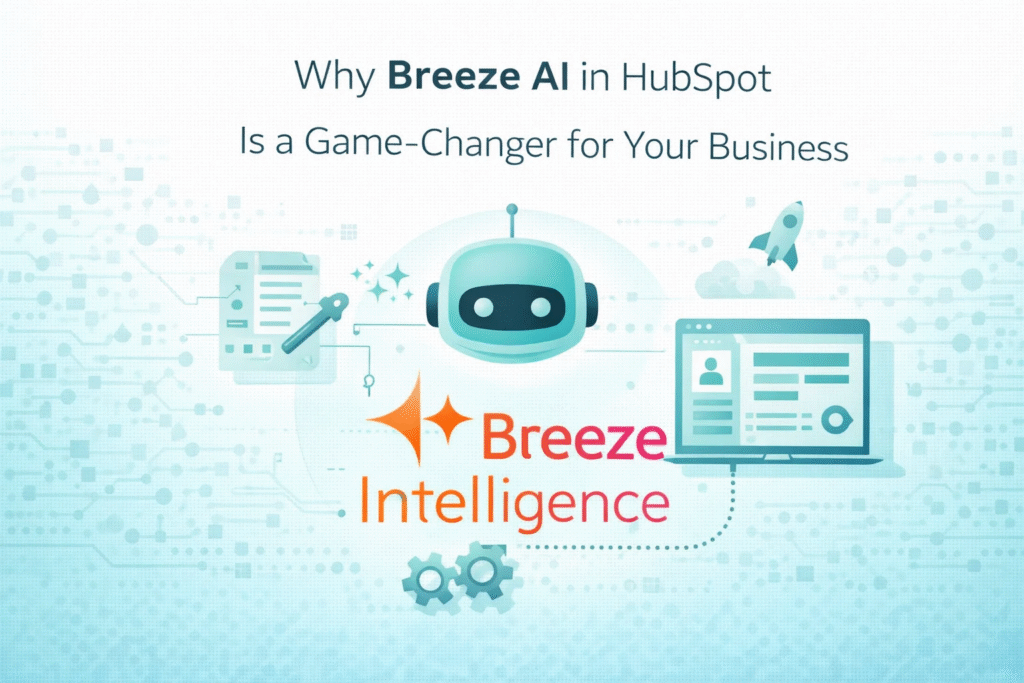

Speed matters, but moving fast in the wrong direction creates operational noise. HubSpot combines its workflow tools with Breeze Intelligence to keep teams moving with clarity.
Breeze Intelligence enriches your contact and company database automatically. It fills in missing company details, tracks buyer intent signals, and highlights which visitors are actively researching your solutions. Sales representatives stop wasting time calling dead leads and instead focus their energy on prospects who are ready to talk.
Accessible for Teams of Any Size
High-end software platforms often come with steep price tags and months of setup. HubSpot maintains an accessible entry point that works for growing businesses:
- Free CRM Tier: Includes core tools like deal tracking, email templates, contact management, meeting scheduling, and live chat for up to two users and 1,000 contacts.
- Scalable Growth: Companies can start with simple tools and unlock advanced hubs, automation, and AI credits as their revenue expands.
- HubSpot Academy: Offers free, self-paced courses, certifications, and practical workshops so employees actually learn how to use these systems effectively.
This combination of free tools and free education ensures that teams do not just buy software—they successfully adopt it.
Summary of Core Advantages
| Platform Feature | Primary Business Benefit | Real-World Result |
| Smart CRM | Unifies contact, deal, and service data into one record | Prevents data silos and gives AI full context |
| Agent Hub | Centralized management for autonomous AI workflows | Replaces scattered, unmanaged AI tools |
| Breeze Studio | No-code custom agent builder using plain prompts & CRM data | Allows non-technical teams to automate work fast |
| Breeze Intelligence | Automatic data enrichment & buyer intent tracking | Helps sales reps focus only on high-value leads |
| HubSpot Academy | Free training and professional certifications | Guarantees high adoption rates across the team |
The Human Advantage Remains the Priorit

The goal of HubSpot’s AI isn’t to replace human workers. It is to give people leverage.
By automating repetitive tasks like data entry, ticket logging, and initial research, HubSpot frees employees to do what humans do best: build relationships, solve nuanced problems, and make strategic decisions. That balanced “human-in-the-loop” model is why HubSpot feels practical, reliable, and grounded for modern operations.